· Adam Wynne · AI-first Product Engineering · 12 min read
What is AI-first Product Engineering?
From product vision to technical specs to production: Product context is the missing link for AI agents to build the right product, fast.
TL;DR: AI-first Product Engineering combines AI-accelerated product discipline with AI-driven implementation, shifting the bottleneck from building to understanding what to build. It’s not about coding faster. It’s about learning faster.
The State of AI Coding
AI coding tools promise huge gains in productivity for two distinct types of software builders. For professional software engineers, the promise is that they can write high quality code faster than ever before. Non-engineers now have the power to build fully functional applications.
For Professional Software Engineers
Tools like Claude Code, OpenAI Codex, and Cursor have revolutionized software engineering seemingly overnight, proving themselves to be true force multipliers in terms of raw programming speed. The momentum is undeniable; development teams across the industry are rushing to integrate these tools, betting their future productivity on AI-powered workflows.
However, the quantitative research paints a mixed picture. While a prominent GitHub study showed that developers using Copilot complete tasks 55% faster, MIT found numerous roadblocks to effective adoption of AI coding agents. The problems include brittle workflows, unreliable outputs when scaling, and a persistent misalignment between business goals and AI’s current capabilities.
These problems share a common root cause. In their comprehensive AI-first software engineering analysis, ThoughtWorks identifies something crucial: AI “amplifies indiscriminately.” Think about that. Your AI coding assistant doesn’t distinguish between solid architecture and fragile implementations. It accelerates both equally.
This explains a troubling pattern emerging across the industry. Code churn metrics are rising (see the ThoughtWorks article). Quality issues accumulate faster than teams can address them. ThoughtWorks calls this the “quality degradation cycle,” when speed without strategic direction compounds problems instead of solving them. You ship faster, but you’re also breaking things faster.
This pattern holds whether you’re a solo developer or an enterprise team. Without clear product direction and quality guardrails, AI’s speed advantage becomes a liability.
For Non-Engineers
For non-engineers, a new category of vibe-coding tools (such as Replit, Lovable, v0, and many others) promises to turn prompts into working apps. The pitch is seductive: describe what you want, watch it materialize. No code required. As Andrej Karpathy noted, in this new kind of coding, you forget the code even exists.
This method produces demos that are genuinely impressive. Natural language becomes UI scaffolding, component libraries, even backend logic. You can build something functional in an afternoon.
Here’s the problem: functional isn’t production-ready.
These tools excel at prototyping, but they collapse when you need security, scalability, or maintainability. The gap between impressive demo and production system is wider than it appears.
Where does this leave us?
Here’s the uncomfortable truth: both approaches hit the same wall. AI makes you faster, but speed without direction is just expensive chaos.
Building the wrong product 55% faster is 55% more expensive.
We’ve been asking the wrong questions. Instead of “How do I code faster?” or “How do I build without coding?”, we need to ask the fundamental product engineering questions:
- Are we building the right thing?
- Are we building it right?
These aren’t new questions; they’re core to good product engineering.
What is new is using AI to systematically enforce these questions while accelerating the entire process. That’s AI-first Product Engineering.
The Critical Distinction: AI-first Product Engineering vs AI-first Programming
Many teams are approaching AI development like this:
Current AI Coding Narrative
“I have code to write, let me use AI to write it faster”
This narrative starts with technical implementation. Product definition and user research happen separately. AI assists the developer, but there’s no structured product context to ensure the right thing is being built. Without systematic ways to answer those two fundamental questions (are we building the right thing, and building it right), AI’s amplifying effect makes a weak process even worse.
Many dev teams are being pushed to “embrace AI” to increase velocity, applying these tools to their existing process as is, often with unexpected consequences.
The Stack Overflow 2025 Developer Survey reveals that while 80% of developers now use AI tools, trust has declined: 45% cite an increased need to fix AI-generated code. Time spent debugging and accruing technical debt erodes the promised productivity gains.
This is AI-first programming: faster typing, not better products.
Technical adjustments can help: automated testing, AI-assisted code review, modified workflows. But they don’t address the core problem: AI amplifies whatever process you have. Without engineering standards, you get fragile code faster. Without product context, you build the wrong thing faster.
What we need is an AI-enhanced product architecture discipline that lets us track and guide the product as it evolves at AI speed.
AI-first Product Engineering is different
“Let me define the product in detail, set up professional engineering guardrails, then let AI build the solution while validating both product and technical fidelity”
- Product definition first: AI helps rigorously define user problems and solutions before technical specs. You solve the “what to build” problem upfront.
- Production-ready from the start: Professional engineering practices built in (specs, testing, security, architecture), not bolted on later.
- AI executes with full context: Semi-autonomous implementation guided by both product goals and engineering standards.
- Continuous validation: Automated checks against user outcomes and technical quality. Success measured by user value delivered, not features shipped.
The goal isn’t to write code faster. It’s to learn what users need faster AND ensure what you build is production-ready. By combining large language models with product discipline and engineering rigor, AI-first Product Engineering shifts your bottleneck from “building” to “understanding what to build” while maintaining the quality to ship it.
What is AI-first Product Engineering?
AI-first Product Engineering leverages AI throughout the entire product lifecycle (discovery to deployment) while keeping user outcomes and production quality at the core, not as an afterthought.
It integrates AI-accelerated product discipline with AI-driven implementation and professional engineering practices. Product context guides every technical decision. Quality standards are built in from the start.
Core Principles of AI-first Product Engineering
1. Product Context First
Product context defines what to build and why it matters. Every component has a mission document to guide its development. Every epic defines a user problem and desired outcome. Success metrics measure user value delivered, not features shipped.
This sounds like standard product discipline, but the difference is what happens next.
AI agents load product context documentation files such as mission.md and roadmap.md before seeing code, understanding product goals and dependencies before making tactical decisions. The roadmap tracks user outcomes, not just technical tasks. Discovery work continues alongside development. Product priorities override technical nice-to-haves.
2. Specs Bridge Product and Technical
Spec-driven development is making a comeback because AI agents perform significantly better with detailed technical specs upfront. But standard SDD stops at the technical layer.
AI-first Product Engineering connects the dots differently. Every spec links back to an epic that explains the user problem. Architecture decisions explain why they serve product goals, not just how they work technically. Testing criteria validate both user value and technical quality.
The result: clear traceability from user needs to technical specs to working software.
This linkage is more than just good practice: it’s essential for AI agents. In traditional development, teams with strong product discipline can teach engineers the product values and goals through conversations, standups, and shared context. But AI can’t absorb that institutional knowledge. Without explicit epic-to-spec linkage, AI builds from technical requirements in isolation, missing the user problems that drive those requirements.
Now, when AI generates code, it leverages this epic-to-spec linkage to understand both the user problem AND the technical solution. Instead of building from isolated technical requirements, AI reads the full context: why users need this feature (from the epic) and how to implement it so that it is production-ready (from the spec). The spec becomes the bridge between “what users need” and “how we build it.”
3. AI Accelerates Feature Development and Validation
AI builds fast from well-defined product requirements and engineering specs. This speed enables rapid iteration on multiple product hypotheses. You spend more time discovering and defining what to build because implementation is no longer the bottleneck.
But speed without quality leads to technical debt. That’s where automated validation becomes critical. Every feature passes through validation checkpoints that verify both user value delivery and production readiness: automated test suites, performance benchmarks, and user acceptance criteria. These gates aren’t manual reviews that slow you down; they’re tasks you give to your coding agent.
The result: You can deploy multiple feature variations quickly, validate which ones deliver real user value, and kill the ones that don’t, all while maintaining production-grade quality. Instead of building one feature perfectly over months, you test multiple hypotheses in weeks and double down on what works. AI doesn’t replace good agile practices; it makes them economically viable at much faster cycles.
Here's what changes: you can test more ideas, kill bad ones faster, and ship production-ready features instead of prototypes that need to be rebuilt.
AI-first Product Engineering in practice: The APES Methodology
I’ve codified these practices into APES (AI-first Product Engineering, with Specs). Four phases where AI accelerates proven product engineering practices:
Phase 1: Product Discovery & Definition (Human-Led, AI-Accelerated)
You start by figuring out the actual problem you’re solving and who you’re solving it for. AI can accelerate competitive research, help you draft epics, and speed up discovery work. But you’re making the strategic calls: which problems matter, which users to serve, what outcomes to chase.
Phase 2: Specification Phase (Human-Led, Product-Informed)
Here’s where you write the product context documentation: mission, roadmap, features, and specs that actually connect to user problems. Every spec links back to a feature. Every architecture decision explains not just how it works, but why it serves the product goal. When AI reads these specs, it understands both the user value and the technical approach.
Phase 3: Implementation Phase (AI-Led, Product-Guided)
AI loads your mission, roadmap, and spec documents before writing a single line of code. It builds with full context: what users need and how to build it production-ready. Instead of implementing features one piece at a time, AI generates the application code, automated tests, and infrastructure configuration together.
Phase 4: Validation Phase (User-Focused, AI-Accelerated)
This is where it gets interesting. Implementation is cheap and fast, so you can actually test different approaches to the same user problem. Ship something, measure how users respond, kill it if it doesn’t work, try a different solution. When you can build in weeks instead of months, you can afford to be wrong. And learn fast.
The shift: Most teams build one feature, ship it, and hope users want it. With APES, you ship, measure, pivot, and ship again.
Real-World Example: Building GridPulse
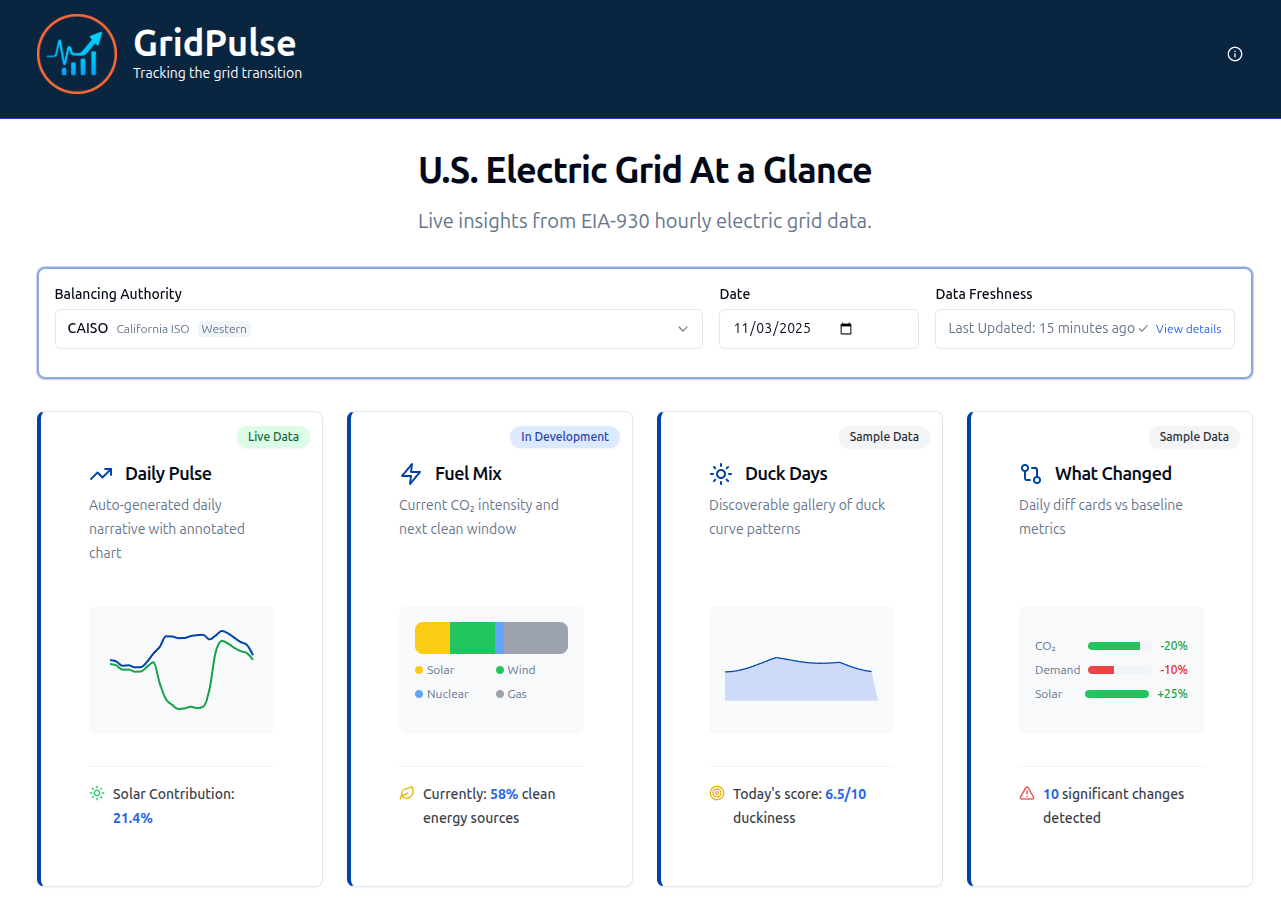
Let me show you how this works in practice with GridPulse, a grid intelligence platform I’m building in the open using AI-first Product Engineering.
How I Built GridPulse
My background is in technical strategy, systems architecture, product engineering, and technical leadership. I’ve spent decades architecting solutions across the entire stack, from IoT to cloud infrastructure, evaluating tradeoffs, and guiding technical decisions.
I chose energy grid analytics because we’re witnessing an exciting confluence of AI demand and energy grid transformation. It’s both a significant market opportunity and a chance to build climate-positive solutions into the grid infrastructure.
Energy grid analytics was challenging territory. Complex domain, real-time data pipelines, multi-service architecture. I had the product vision and architectural knowledge, but I needed to learn the domain while building production infrastructure. AI became the implementation partner that could accelerate both my domain learning and execute on my technical direction.
The process:
I started with four user personas and a mission statement. Then Claude and I wrote epics, features (in user terms), and specs (in technical terms) for four use cases, each tied to specific user outcomes. Claude read those specs and built the microservice architecture I had designed: React, Python, Postgres, Terraform, AWS ECS, and CloudFlare.
In six weeks, I deployed production infrastructure and four feature UIs to AWS ECS. A traditional approach would require assembling a team and months of coordinated development.
What enabled this:
- Structured product documentation that AI referenced throughout development
- AI-driven validation and architecture designed to scale from the start
- Production infrastructure with proper security and cost optimization
The platform is live at gridpulse.us. Two features use real-time grid data pipelines; two use mock data while I validate their usefulness. Low deployment costs let me run extended validation without burning capital.
Why This Matters for Technology Leaders
Your real constraint isn’t developer hours. It’s learning speed. How many product hypotheses can you test before running out of runway?
The numbers are brutal: 42% of startups fail because they build something nobody wants. Both new startups and enterprise software products typically have 12-24 months before they run out of cash or budget. That’s your window.
Traditional development: Most MVPs take 3-4 months to build, with complex features extending to 6 months. At $100k-$200k/month burn rate for a small technical team, each 3-month cycle costs $300k-$600k. Ship, discover users don’t want it, spend another 2-4 months pivoting. Repeat until you find product-market fit or run out of money.
AI-first Product Engineering compresses these cycles:
- 55% faster coding with AI-accelerated implementation
- Product-informed specs that eliminate rework
- Automated testing and deployment
- Continuous validation against user outcomes
With an 18-month runway, you get 2-3x more validated learning cycles before running out of capital. 2-3x more opportunities to find product-market fit.
The team efficiency advantage: AI makes developers more T-shaped. Product managers can prototype features. Architects can validate designs with working code. Senior engineers can contribute outside their specialization. You need fewer people to validate product hypotheses.
The future isn't AI writing code faster. It's AI enabling you to build better products at every stage.
Ready to Ship Your Product Faster?
The APES Framework is a systematic 4-phase approach to AI-first product engineering. See how it works, then explore how we can help with your product.
Already have a product idea you want to discuss? Schedule a Free Consultation